Hybrid Propulsion
A 4+1 quadplane layout combines four high-performance electric lift motors for vertical flight with an ICE pusher engine for long-range cruise, maximising efficiency and stability.

A 65 kg-class hybrid vertical take-off and landing UAV built for top-tier intelligence, surveillance & reconnaissance (ISR) missions
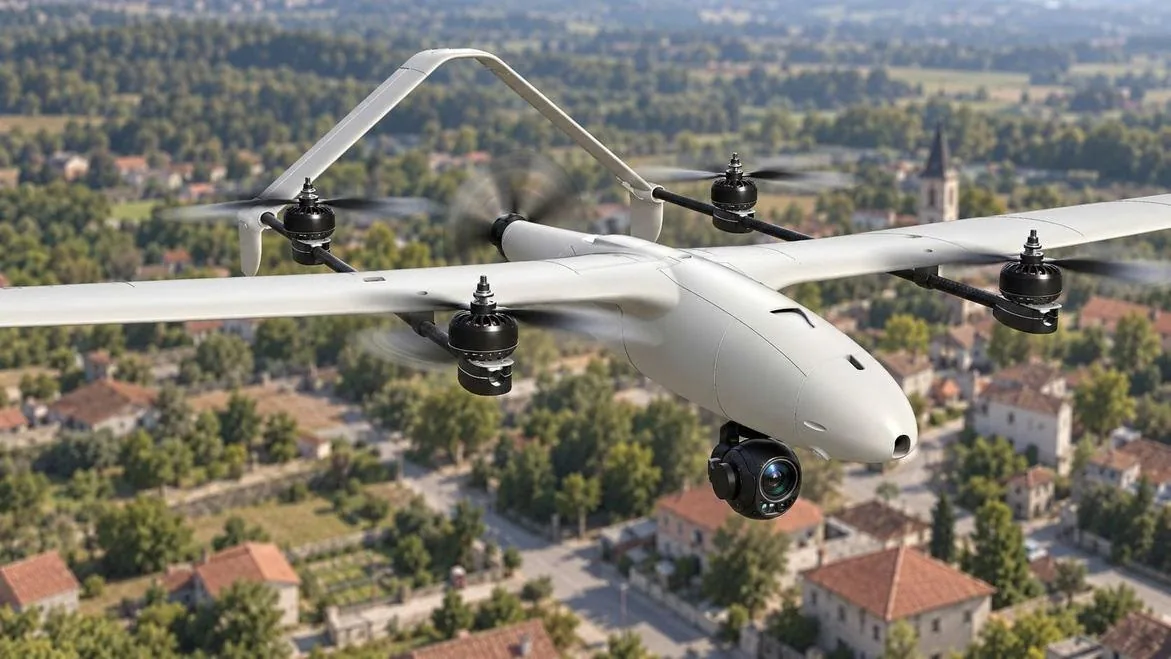
The V-600 takes off and lands vertically without a runway, then cruises on an efficient combustion engine for long-endurance missions. Combined with an advanced AI tracking system, it delivers a next-generation unmanned aerial solution optimised for tactical and industrial field operations.
A 4+1 quadplane layout combines four high-performance electric lift motors for vertical flight with an ICE pusher engine for long-range cruise, maximising efficiency and stability.
At its 65 kg maximum take-off weight it guarantees at least 8 hours of continuous flight (10 hours targeted) with mission payload and a 10% fuel reserve, backed by a 200 km line-of-sight datalink.
A 4K day camera with ≥20× optical zoom, a thermal sensor and a laser rangefinder share one 3-axis stabilised gimbal. On-board AI classifies people and vehicles and locks on to and tracks 10+ targets simultaneously.
A CRPA anti-jam antenna, spoofing detection and GPS-denied dead-reckoning keep it on course, while the 200 km datalink is protected by AES-256 encryption and MAVLink 2 message signing.
Lidar and radar altimeters enable fully automatic vertical take-off and landing — no runway, catapult or recovery net required. IP54 protection allows missions in light rain.
| Air Vehicle & Performance | |
|---|---|
| Configuration | Fixed-wing VTOL, quadplane 4+1; ICE pusher engine for cruise and four electric lift motors for vertical take-off and landing |
| Max Take-Off Weight | 60–65 kg (65 kg MTOW) |
| Endurance / Fuel | Minimum 8 h at MTOW with mission payload and 10% fuel reserve; 10 h target. Usable fuel ≥ 19 L; fuel tank ≥ 20 L |
| Operating Altitude | Typical operation up to 2,000 m AGL; service ceiling 4,500 m MSL. Take-off and landing sites from sea level to 2,300 m MSL |
| Speed / Wind | Cruise 85–110 km/h TAS; maximum ≥ 130 km/h TAS. Take-off/landing in ≥ 10 m/s steady wind and 15 m/s gusts |
| Propulsion & Power | |
| Cruise Propulsion | Naturally aspirated EFI engine with dedicated ECU; ≥ 3.8 kW continuous shaft power at 4,500 m MSL (sea-level rating ≥ 7.5 kW / 10 hp) |
| VTOL Lift System | Four 12S lift motors with 30–32 in carbon propellers; ≥ 33 kgf peak sea-level thrust each. Lift thrust-to-weight ratio ≥ 1.4 at 2,300 m MSL and +40 °C |
| Electrical System | Generator output ≥ 350 W continuous at cruise RPM at 4,500 m MSL; redundant power monitoring with uninterrupted automatic avionics-bus switchover |
| Battery Architecture | Two 12S VTOL packs and two 6S avionics packs, each pair in parallel; total battery mass ≤ 12.5 kg |
| Mission Payload & AI | |
| EO Camera | 8 MP class, 4K video, ≥ 20× optical and ≥ 12× digital zoom |
| Thermal Camera | Uncooled VOx LWIR, 640 × 512, 12 µm pixel pitch, 35 mm athermal lens; NETD ≤ 50 mK |
| Laser Rangefinder | 1,535 nm; range ≥ 3,000 m to vehicle and ≥ 2,000 m to person; accuracy ±1 m |
| AI Functions | EO/IR detection and classification of people and vehicles; simultaneous tracking of ≥ 10 targets; selected-target lock/follow and target GPS-coordinate resolution |
| Gimbal | 3-axis stabilisation, accuracy ±0.02°; 360° pan and −90° downward view. Payload mass 1.1–1.3 kg (max 2.0 kg incl. damper) |
| Flight Control, Navigation & Communications | |
| Flight Control | ArduPilot (ArduPlane QuadPlane) ≥ 4.5; DroneCAN sensors and interfaces preferred |
| Navigation Resilience | Dual multi-constellation, multi-band RTK GNSS receivers; CRPA anti-jam antenna (≥ 4 elements); spoofing detection and GPS-denied dead-reckoning |
| Datalink | 200 km C2, video and pilot-control range (line of sight); primary encrypted IP link ≥ 8 Mbps at 200 km plus independent backup C2 link |
| Security / Video | AES-256 link encryption and MAVLink 2 message signing; EO/IR video in H.264/H.265 with AI target metadata |
| Ground Segment & Environment | |
| Ground Control | Two operator stations (pilot and payload/AI operator), joystick/RC manual control, antenna tracker, extendable antenna mast, RTK base station and mission-planning software |
| Environment | Ground operation −5 °C to +40 °C; airborne equipment down to −35 °C. IP54 air-vehicle protection; light-rain operation |
| Recovery / Safety | Vertical take-off and landing without runway, catapult or recovery net; lidar and radar altimeters for automatic take-off/landing; configurable flight and link-loss failsafes |
Specifications reflect target system requirements and may change during development.
Contact us for mission configurations, demonstrations and pricing.